



Award-Winning Features to Start Your AI Journey with Confidence
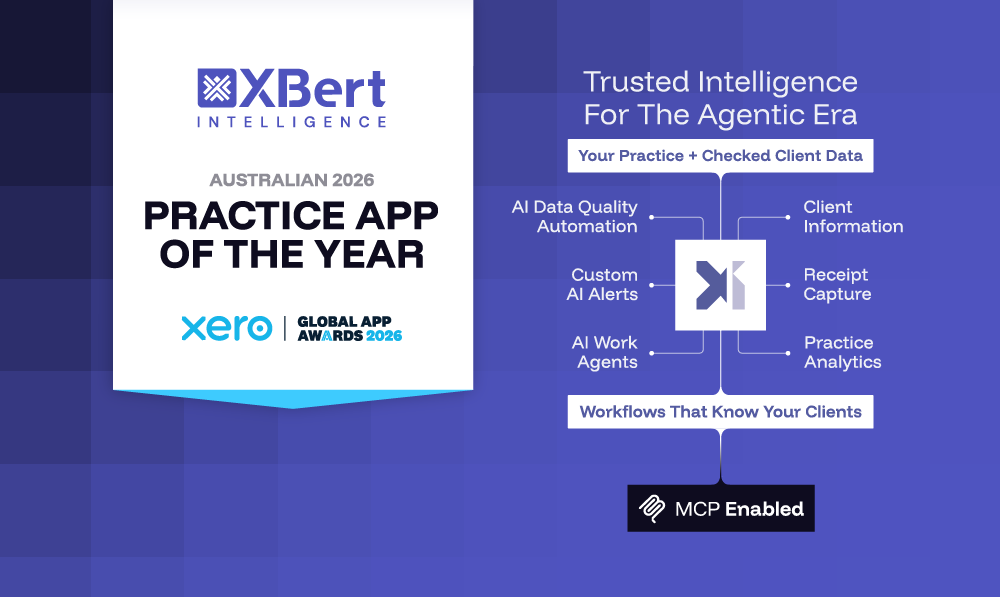
Xero's 2026 Practice App of the Year (Australia) wasn't built on a feature list. It was built on one thing: a trusted, checked data layer - delivered by workflows that know what's inside every client's ledger.
You are accountable for every client ledger in your book. And there is a hard limit on how many of them you can actually read, every month, every transaction, before something slips. Most firms hit that limit and respond the same way: they hire, they sample, or they catch the error at BAS time and fix it quietly.
XBert won Practice App of the Year (Australia) at the 2026 Xero Global App Awards by arguing there is a fourth option. The award submission barely mentioned features. It argued that detection without routing is worthless, and that a workflow connected to live ledger data produces a fundamentally different outcome than a workflow that just tracks tasks. Judges across five categories, including Global Innovation App of the Year, assessed that argument. The full demonstration of what they saw is now in the replay, and if you trialled an older version of XBert or evaluated it against other tools without seeing the current product, this is what you missed.
Most practice tools track work. XBert understands it
Every workflow tool your firm has looked at does the same basic thing. It holds a list of work, shows who it is assigned to, and tells you when it is due. That is useful. It is also entirely disconnected from what is happening inside your clients' books.
When a bank account goes unreconciled for six weeks, your task board does not know. When a contact is missing a tax number, nothing in your worklist changes. The error sits in the ledger, invisible to the workflow, until someone opens that specific file on that specific day and happens to notice.
XBert's layer is different because it is built on live accounting data. An anomaly in a client's file becomes a task on the board, with a risk level, a risk value, an explanation and resolution steps, and an assigned team member. Not because someone found it. Because the workflow is connected to the data.
"A human can look at reports but you're not going to consistently examine every single transaction that's in every client's Xero file every single month. You just... it's not going to happen." - Shann Curtin, Copia Business Services
That is the structural problem the award submission addressed. And it is the problem the live demo was built to show.
What our recent webinar showed that a feature list never could
The session opened with Custom XBerts. The host typed a monitoring condition in plain English, and the audience watched it build into a deterministic check running across the entire client book. No code. No configuration beyond the sentence itself. The alert landed on the work board as a task.
Then came the self-learning moment. A finding was confirmed on screen, another dismissed. The monitor tuned from that feedback automatically, without anyone adjusting a rule. That is not novelty. That is the mechanism that makes a monitor trustworthy over time, because it sharpens from the professional judgement of your team rather than from a vendor's assumptions about your clients.
After Custom XBerts, the demo moved to the built-in check library. 150+ checks run globally across all connected ledgers, with 40 to 95 active in any single region. Findings appear with risk value attached. Some can be resolved directly in XBert using Auto-Resolve, with the fix written back to the ledger, without opening the accounting file at all.
The question that used to take an afternoon
One section of the demo has been the most talked-about since the session closed. The host opened XI Chat and typed a whole-of-practice question. The kind of question that normally means assembling four screens, building an export, and calling the person who knows the answer because the export is already out of date.
The answer came back in seconds, drawn from live ledger data across the connected client book.
That capability matters because the bottleneck in most practices is not the work itself. It is the time spent finding out where the work stands, which clients need attention, which team members are stretched, and whether the file is clean before it goes out. When that friction drops, the capacity that was locked inside it becomes available for something else.
Firms that have removed it report real numbers. Greenspace Bookkeeping recorded a 150% improvement in workflow administration efficiency. CloudMind doubled clients without adding staff. XBert's own ROI Analytics engine, which tracks time saved against actual work completed, shows 0.6 to 5 hours saved per client per month on built-in checks alone across a 100-client practice, and up to 10 hours per client per month for firms using custom alerts.
"It's rare to find a tool that not only meets our complex project management needs but also provides such outstanding support. Highly recommended for any team looking to elevate their AI and project management game!" - Stacey Nielsen, Book Metrics
Connecting the AI your firm already uses
The final section of the demo covered the MCP Gateway. Model Context Protocol, MCP, is the open standard that lets AI assistants connect to external data sources directly. Anthropic described it as USB-C for AI: one standard connector instead of a drawer of incompatible cables.
The XBert MCP Gateway gives Claude, ChatGPT or any MCP-aware assistant a single secure connection into XBert. The assistant signs in under a named user's normal XBert login and inherits that person's permissions exactly. There is no firm-wide super-user mode. Anything that changes data is proposed for review, validated and duplicate-checked before it reaches the ledger. Every call writes an audit line.
The trust argument is worth stating plainly. AI is only as good as the data it reads. The data on the other side of this connection has already been through 150+ continuously running checks, with a human in the loop on every resolution. Your AI is not answering from a stale export. It is answering from checked, live numbers.
Setup in the demo took under five minutes. One address pasted, one sign-in, no code, no API keys.
Why the award is evidence, not decoration
Xero's judges assessed the product across five categories. XBert won Practice App of the Year (Australia) and was a finalist for Global Innovation App of the Year alongside recognition in three other categories. We are proud to be acknowledged as the Best Bookkeeping Management tool - and have 100% 5.0 star reviews on the Xero App Store.
None of that is what you should act on. What you should act on is whether the demo showed you something your current workflow cannot do. If you have not watched it, the replay is the right next step. Watch it with the question in mind: not what does XBert do, but what would your team stop having to do.
If you trialled an older version, the product has moved significantly. The Custom XBerts framework, XI Chat, and the MCP Gateway are all present-tense capabilities, not roadmap. The 14-day free trial requires no credit card. Load a few files and see what surfaces.
If you'd like to see how our checked trusted data layer comes together - watch the webinar replay.
Start your free trial (https://app.xbert.io/account/sign-up) or book a 40-minute demo (https://www.xbert.io/xbert-meeting-select-region) to see the current product at work.
Be the go-to firm with the latest AI tech.

