



Your Under-Recovered Fees Are Already in Your Data
Connect XBert and Ignition to the AI assistant you already use, and a fee review becomes a question, not a project.
Most practices have at least one client like this. Quoted as tidy books three years ago. Now they send a shoebox, call on Fridays, and need "just one more thing" every month-end. The fee hasn't moved. The work has.
XBert already shows you this. Activity volumes, alert patterns, the slow creep of complexity across a ledger-it's all there. The problem isn't that the data is missing. It's that you can't quickly match it against what you're actually billing. That data lives in Ignition. And without connecting the two, the fee conversation either doesn't happen or you walk in with a hunch instead of a number.
On Thursday 15 October at 12 noon AEDT, Cassandra Scott, Ethan Cooney and Jack Colvin will show you how to close that gap in one question. If you're already using XBert, Ignition, or both, this session is built for you.
Why the fee never catches up
Fees get set at onboarding. Everyone knows this. What's harder to see is how far some of them drift over time, because the billing evidence sits in a different system.
XBert already tells you how much activity is running through a client's ledger. It surfaces the alerts, the volume changes, the patterns that signal a client's complexity has grown. What it can't tell you, on its own, is whether your Ignition billing has kept pace. So the review that would surface that gap becomes a project, and projects get scheduled, and scheduled things get deferred.
Over half of Australian accounting and bookkeeping firms have clients they aren't billing for the extra work. On average, unrecovered out-of-scope work costs Australian firms over $100,000 a year. That cost repeats every year the fee isn't reviewed. This is Ignition and YouGov research, drawn from 557 Australian firms, and Ethan will present it in full on Thursday.
It isn't a pricing problem. It's a visibility problem.
The month-end scramble is full of clients who expanded scope incrementally. One new employee added to payroll. One new bank account. A second entity connected. Each change was small. Together, they represent hours that aren't in the engagement letter. The fee conversation that should follow each change gets absorbed into the week instead.
When you can finally see the gap, the conversation is easy. The reason it doesn't happen is almost never reluctance. It's that there's no quick way to know which clients to have it with.
One question, across both systems
XBert and Ignition each connect to Claude or ChatGPT and Copilot through their own connectors. Once connected, your AI assistant can read across both: activity data in XBert, billing data in Ignition, in one session, without exporting anything.
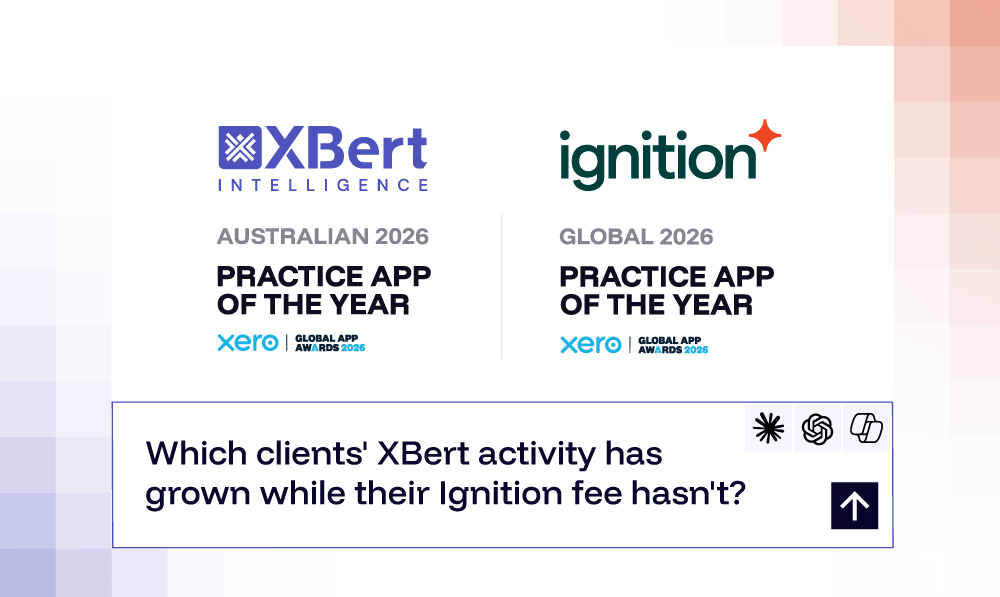
The question Ethan will ask live on Thursday is this: which clients' XBert activity has grown while their Ignition fee hasn't?
Your AI returns the list, showing each client's activity growth alongside their fee movement. One client gets opened in Ignition. Proposed against billed, side by side. The whole thing takes minutes, not a morning.
This is the live demo at the centre of Thursday's session, run against a connected demo practice. You'll see the question, the answer, and the client. Then you'll see exactly what you need to run it yourself: your XBert login, your Ignition login, and Claude or ChatGPT.
If you ran that question on your own book today, which client would come up first?
What you'll walk away with
By the end of the session you'll:
- Understand why scope creep goes unnoticed when your ledger data and billing data sit in separate systems, which is a structural problem, not a habits problem
- See one question asked across XBert and Ignition that surfaces which clients' activity has grown while their fee hasn't
- Leave with that exact question to run on your own book, and a clear picture of what you need to connect
XBert won Practice App of the Year Australia at the Xero Global App Awards 2026. Ignition won Global Practice App of the Year at the same awards. This session brings both platforms to one question that most practices haven't been able to answer quickly.
Join Cassandra, Ethan and Jack on Thursday
The session is sixty minutes, live, with Cassandra Scott hosting from XBert, Ethan Cooney presenting the Ignition side and Jack Colvin from Counting Clouds joining as a mutual customer speaker.
Already using XBert and Ignition? Book a demo and we'll walk you through the connection live. New to either? Start your free trial.
Thursday 15 October, 12PM AEDT (11am QLD). Register here
The fees you've already earned are in your data. This session shows you where.

